Revealing an RPG map gradually: covers, cards and folded paper
- By
- expenseforge.com
- Published
- Reading time
- 6 min
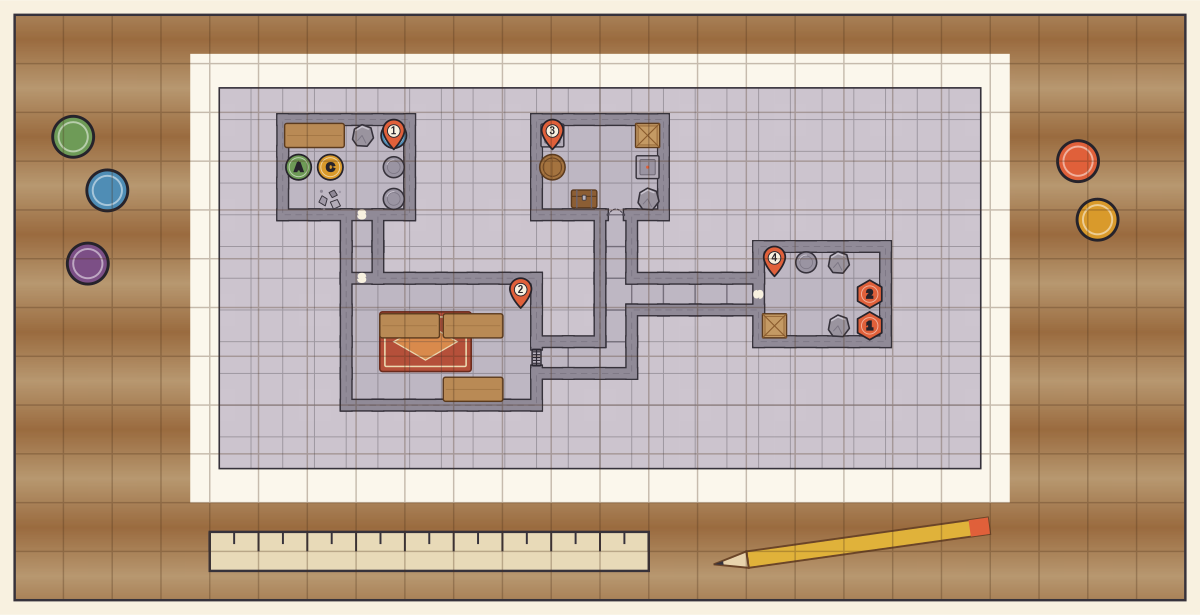
Put a full dungeon map on the table and the players know where every door leads before they open one. Hide the whole thing and they lose the sense of space that a map exists to give. The useful middle is to show what the characters could see from where they stand, and nothing beyond it.
You will find four physical ways to reveal a map, a rule for deciding what to show at each step, and a method for keeping a second copy for yourself with the details players should not see yet.
Decide what to reveal at each step
Reveal what a character could perceive from the current position. That usually means the shape of the space, its large features and its visible exits. It does not include what lies behind a closed door, under a floor or inside a cabinet.
Think of three levels of information, each shown at its own moment.
| Level | What players see | Trigger | Common method |
|---|---|---|---|
| Outline | Walls, floor shape and size | The party steps in | Uncover the room |
| Contents | Furniture, objects and features | A look around | Place loose pieces |
| Exits | Doors, stairs and passages | They notice them | Open the cover further |
| Hidden detail | Concealed doors and traps | A successful search | Add after discovery |
Reveal exits as closed or open, not as destinations. A door shown on the map tells players that a door exists, and the room behind it stays covered until they go through.
When unsure, show less and answer questions with more. A player who asks what the room looks like is doing the exploring you want, and a short reply fills the gap. A detail shown too early cannot be taken back, while a detail added later spoils nothing. The last row of the table, hidden detail, is a craft of its own: secret doors and hidden passages explains how to draw them so they feel fair once found.
Cover sheets and sliding paper
The simplest method is a sheet of plain paper laid over the part of the map the party has not reached. Slide it back along the party's route as they move, one room or one corridor stretch at a time.
Keep these details in mind:
- Opacity. Thin printer paper shows dark print through it. Use heavier paper or two sheets layered, and test by holding one sheet over a printed page.
- Edges. Line cover edges up with walls and doors, never through the middle of a room. A clean edge reads as a wall; a ragged one tells players a room is ahead.
- Anchoring. Hold the cover with a short strip of removable tape on its far side, so it stays put when someone leans on the table.
- Overlap. Cover a little beyond the next room, so a door at the edge stays closed until someone opens it.
Cover sheets work best for maps that fit on one table, where the party moves in a mostly straight line. When the party backtracks, slide a sheet back over a room they have left only if the group agrees it is out of sight. Otherwise leave it open, because players use a revealed room to plan the way out.
Room cards and sectional maps
For maps with several branches, print or draw each room on its own sheet and lay them down as the party arrives. Matching door squares link the pieces. Write a small letter by each door on both pieces, such as "A" on a corridor and "A" on the room it enters, so the pairs can be found in seconds. Stack the pieces in the order they may appear, and pencil a number on the back of each, so the next one is always on top.
This method never leaves a gap or a ragged cover edge, and players can see exactly how the dungeon grows. The drawback is that loose pieces slide, so a firm backing or a few light strips of tape on the table help.
When the cuts of a large printed map fall between rooms, each page can serve as its own card. Splitting a large map over several sheets explains how to place seams so they fall there.
Folded paper and window cards
A fold hides a region without a second piece of paper. Crease the map along a wall line and tuck the unexplored section behind. Unfold it as the party moves ahead. A fold along a wall reads as the edge of the space, while a fold through the middle of a room is obvious.
For a long corridor or a winding passage, an accordion fold gives you a reveal that advances one stretch at a time.
A window card is the third option. Cut a rectangular hole in a sheet of card and slide it over the map to show only the party's surroundings. A window of 6 by 6 squares shows 30 by 30 ft (9 by 9 m) at 5 ft (1.5 m) per square, which is a reasonable choice for a dim hall. Resize the window to match the light in the scene: smaller in a cave, larger in an open field.
Keep a GM copy and a player copy
The map you hold has secrets, keys and notes. The map the players see should show the same space without them. Keep two versions from the start, so there is never a risk of pointing at a note you wanted hidden.
In the Map Builder, keep traps on the Objects layer and notes and labels on the Notes layer, and use the visibility switch of each layer to check how the map looks without them. The secret door piece sits on the Walls layer, so it has to be deleted and replaced with a plain wall segment. For the player copy, download the full map file, delete the secret pieces, then download it again under a second name and print that version.
Prepare the player copy and the covers with this list:
- The player copy has no hidden doors, trap marks or notes.
- Cover sheets are thick enough that no print shows through.
- Reveal edges follow walls and doors.
- The first room is uncovered; everything else is covered.
- The GM copy is within reach and the player copy is not.
Common mistakes
- Showing the whole map to save time. The first room is all that players need. Cover the rest.
- Hiding too much. Players cannot plan without the room's shape and its exits. Always show the outline and the doors they can see.
- Using thin cover sheets. Print shows through and spoils the surprise. Test every cover before the session.
- Cutting reveals through the middle of a room. A ragged edge draws attention and may hint at what is hidden. Cut along walls.
- Revealing in the order of your notes, not their route. Follow where the party goes, even when it is not the path you planned.
FAQ
What should players always be able to see?
The outline of the space they are in, its visible exits and any large feature a character would notice at once. Players cannot make choices about a place they cannot picture. Hold back only what is concealed, behind a closed door or out of sight from the party's position.
How is a room revealed when its door has not been opened?
Leave the room covered and show only the door itself. When the door opens, slide the cover back far enough to show what a character would see through the gap, usually a strip of floor and a wall. Uncover the rest as the party steps through.
Can the map be drawn as the party explores?
Yes. Drawing on a blank grid as players describe their route makes the map a record of what they have found, and no cover is needed. The drawbacks are time and a messier result, so it suits slow, quiet exploration better than a busy scene.
Which method suits a small table?
Cover sheets and window cards take the least space, because nothing extra sits on the table beyond the map itself. Room cards need more surface for loose pieces. Setting up a map on a small table explains how to make room for each.
Sources
- Wood, Denis. The Power of Maps. Guilford Press, 1992. For how a map shows some things and leaves others out, and what that does to its reader.
- Monmonier, Mark. How to Lie with Maps. 3rd ed. University of Chicago Press, 2018. For how omission and emphasis shape what a map tells people.
- Schell, Jesse. The Art of Game Design: A Book of Lenses. 3rd ed. CRC Press, 2019. For how curiosity and uncertainty keep players interested in what comes next.
- Passini, Romedi. Wayfinding in Architecture. Van Nostrand Reinhold, 1984. For how people use what they can see to decide where to go.