Bridge, ford and stepping-stone crossings as scene locations
- By
- expenseforge.com
- Published
- Reading time
- 6 min
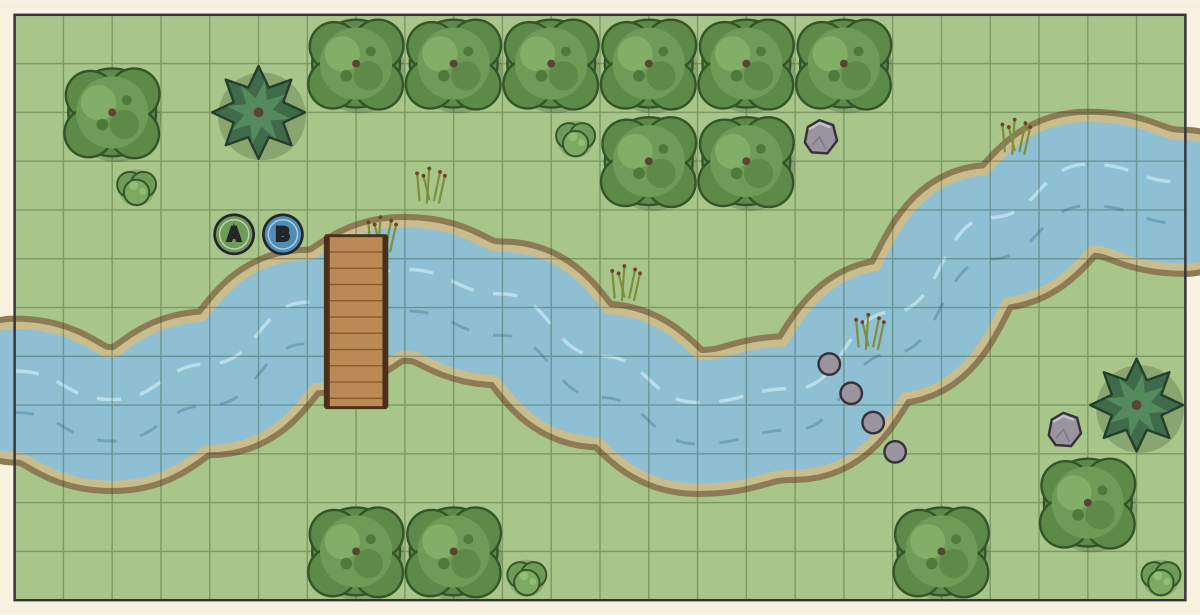
A river on a map is only an obstacle until someone has to cross it. The crossing is where the scene lives: the choice of route, the narrow gap, the wait on the far bank. Too often it is a single bridge drawn as a gray bar and then forgotten.
This guide covers three kinds of crossing, the bridge, the ford and the stepping-stone line. You will size each one in squares, build the approach on both banks, and decide what the crossing does to the pace of a scene.
Three crossings, three kinds of scene
Each crossing shapes movement differently, so pick the one that fits the scene you want. A bridge is fast and predictable: everyone can see it, and everyone knows how many figures fit on it. A ford is slow and open, because the whole group is in the water at once. A line of stepping stones is slower still, and it forces figures to go one at a time.
| Crossing | Typical width | Pace | Best for |
|---|---|---|---|
| Bridge | 1 to 3 squares | Fast, steady | A standoff, a chase, a gathering |
| Ford | 3 to 5 squares | Slow, exposed | A group moving together |
| Stepping stones | 1 square per stone | One at a time | A tense, careful crossing |
| Fallen log | 1 square | Single file | A quick shortcut |
Decide what the scene needs before you draw. If you want the players to meet someone halfway, a bridge gives a clear middle. If you want them to be caught in the open, a ford does it. If you want a small obstacle that tests the group, stones or a log suit best.
Whichever you choose, tie it to the river around it. River map design explains where crossings sit naturally, which is usually where the river widens, slows and gets shallow.
Designing a bridge
Start with the width. A bridge 1 square wide forces single file and makes every figure on it easy to watch or block. A bridge 2 squares wide lets two figures stand abreast. A bridge 3 squares wide can carry a cart with room to spare. Choose on purpose, since the width sets how the scene plays.
Length equals the river width plus a square of bank at each end. In a timber bridge, planks usually run across the deck, so draw the plank lines at right angles to the direction of travel. A stone bridge often has an arched span with low walls along both sides, and a timber one may have a low railing or none at all. Both give you edges to use as cover or as a place from which to look down.
Put the bridge near a feature the eye can find, such as a large tree, a stone post or a bend in the path. Trails and roads on maps shows how paths should meet a crossing so it looks used.
Designing a ford
A ford is a shallow place where a river can be crossed on foot. It usually forms where the river spreads out and the bed is firm, such as gravel. Draw it as a lighter band of water across the full width, with ripples or small stones, flanked by darker, deeper water upstream and downstream.
Make the ford wide: 3 to 5 squares, which is 15 to 25 ft (4.5 to 7.5 m) at 5 ft per square. That is wider than a bridge, because a ford is a stretch of the river, not a built structure. The group enters the water together and takes several moves to cross, so the middle of the ford is the most exposed part of the scene.
Mark the ford so players can read it. Worn tracks should run down each bank and meet at the water's edge, and a pair of posts or a line of larger stones can show the safe line. The deeper pools on each side are an unspoken warning, and the players learn that stepping off the lighter band is a choice. Keep the shallow band in the same tone you use for shallows everywhere on the map.
Stepping stones and fallen logs
Stepping stones turn a crossing into a small puzzle. Each stone is a square where a figure can stand, so place them in a path across the water. Stones in adjacent squares make an easy line, and stones with a gap of one square make a jump of 5 ft (1.5 m) or more.
A zigzag line feels more natural than a straight one, and it lets you offer choices: two stones side by side near the middle, a long gap towards the far bank. Six or seven stones across a river 5 squares wide is plenty. Vary the sizes, so a few stones take two squares and one is only half out of the water.
A fallen log is the simplest crossing: 1 square wide and 3 to 5 squares long. It gives single-file movement without any building, and it belongs where the river runs past a bank with trees. In the Map Builder, use the boulder piece for stones and the log piece for a trunk, both placed on the Objects layer above the water floor area. There is no dedicated bridge piece, so build a bridge from a wood floor area with low fence pieces along the edges.
The two banks: approaches, cover and sight lines
A crossing needs space on both banks. Leave a landing area of about 4 by 4 squares on each side, so figures have somewhere to stand before and after they cross. Without it, the map has a bridge but no scene, since nobody has room to wait, regroup or watch.
Give each bank a different character. A high bank with trees and rocks looks down on a low bank of open meadow, and the group on the low side has to decide whether to cross at once or to find another way. Place cover at distances that make the choice real: a boulder 3 squares from the bridge, a thicket 8 squares away.
Think about sight lines along the river. A bridge in the middle of a long straight reach is visible from far away. A bridge just around a bend is a surprise. Corridor width and chokepoints covers how narrow routes shape pace, and the same thinking applies to a bridge, which is a corridor over water.
- Crossing type chosen to fit the scene
- Width set in squares on purpose
- A landing area of about 4 by 4 squares on each bank
- Tracks on both banks that lead to the crossing
- Cover at two or more distances from the crossing
Common mistakes
- A bridge with no approach. A bar over water with nothing at either end gives players nowhere to stand. Add a landing area and a path.
- One width for all crossings. A bridge 1 square wide plays differently from one that is 3 squares. Pick the width to match the scene.
- A ford drawn as a bridge. A ford is wide and open, not a narrow strip. Draw it as a lighter band of water across the whole river.
- Stones all in a line. A perfectly straight line looks placed. Zigzag them and leave at least one real choice.
- No sign of use. A crossing with no tracks looks invented. Draw worn paths that arrive from both sides.
FAQ
How wide should a bridge be on a battle map?
Use 1 square for single file, 2 squares for two figures side by side, and 3 squares for a cart. At 5 ft per square, those are 5, 10 and 15 ft (1.5, 3 and 4.5 m). Pick the width to suit how crowded you want the scene to be.
How do you draw a ford on a map?
Draw a lighter band of water across the whole river, 3 to 5 squares wide, with ripples or small stones. Put darker, deeper water upstream and downstream, and run worn tracks down both banks to the water's edge so the ford looks used.
How many stepping stones should a crossing have?
For a river 5 squares wide, six or seven stones is plenty, placed in a zigzag. Put at least one choice in the line, such as two stones side by side or a longer gap, so the crossing is more than a single fixed route.
Can a crossing be part of a fight scene?
Yes. A bridge is a natural chokepoint where only a few figures can stand side by side, and a ford leaves everyone exposed in the water. Plan cover on both banks and a clear route to the crossing so the scene stays readable.
Sources
- Leopold, Luna B. A View of the River. Harvard University Press, 1994. For how rivers change depth and width along their course, which hints at where crossings tend to be.
- Lynch, Kevin. The Image of the City. MIT Press, 1960. For paths, edges and nodes in the way people move through places.
- Totten, Christopher W. An Architectural Approach to Level Design. 2nd ed. CRC Press, 2019. For how thresholds and narrow spaces shape movement in a game level.
- Schell, Jesse. The Art of Game Design: A Book of Lenses. 3rd ed. CRC Press, 2019. For thinking about a scene as a series of meaningful choices.
Also in Open terrain
- D1Forest map design that stays playable
- D2Drawing trees from above on RPG maps
- D3Cave map design without the maze of blobs
- D4River map design: bends, banks and shallows
- D6Trails and roads on wilderness maps
- D7Show hills and cliffs on a grid map
- D8Swamp and lakeshore map design
- D9Campsite and clearing maps for small scenes