How to draw trees from above for a tabletop map
- By
- expenseforge.com
- Published
- Reading time
- 5 min
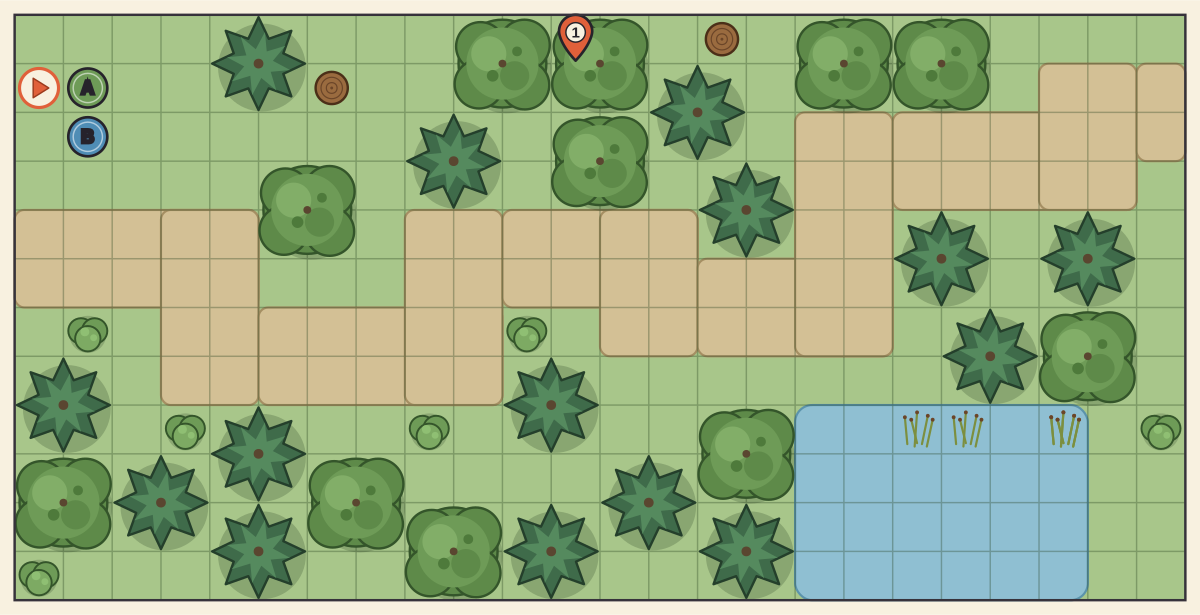
Trees are hard to draw from above because nobody sees them that way. Draw each one as a green circle and the forest looks like a bag of peas. Add too much detail and the figures vanish underneath the leaves.
You will learn a small set of rules for top-down trees: how wide a crown should be in squares, how crowns overlap, where the trunk mark goes, how to vary a group without clutter, and how to decide what counts as cover for a figure standing nearby.
What a tree looks like from directly above
From above, you see the crown, not the trunk. A broadleaf tree reads as a rounded, cloud-like mass with a scalloped edge, because its branches spread in many directions and the leaves gather in clumps. A conifer, such as a pine, reads as a star or a set of radiating tiers, with a tight center where the trunk rises.
Add a small dark dot or ring at the center for the trunk. Strictly, the trunk is hidden under the crown, but a mark in the middle tells the table where the solid part is. That matters later, when someone asks whether a figure can stand behind the tree.
Use two or three tones only: a mid-tone for the crown, a lighter highlight on one side and a darker shade on the opposite side. More tones make the tree busy and hard to read from across the table. Keep the outline slightly irregular, since a perfect circle looks like a button. The color palette guide shows how to choose greens that stay apart on screen and on paper.
Canopy sizes in squares
Crowns vary widely with species, age and growing conditions, so there is no single correct size. Choose a small set of sizes and hold them across the map.
| Plant | Crown width in squares | At 5 ft per square | Role on the map |
|---|---|---|---|
| Bush | 1 | 5 ft (1.5 m) | Low cover, undergrowth |
| Young tree | 2 | 10 ft (3 m) | Fills gaps between large trees |
| Mature tree | 3 to 4 | 15 to 20 ft (4.5 to 6 m) | The main forest tree |
| Old giant | 6 to 8 | 30 to 40 ft (9 to 12 m) | A landmark, one or two per map |
Convert from the real size you have in mind, not from the picture. A crown about 20 ft (6 m) wide is 4 squares at 5 ft per square and 2 squares at 10 ft per square. When you change scale, the tree shrinks on the grid but stays the same in the world. Choosing a scale per square explains how to keep that consistent.
Keep the trunk to 1 square or less. A crown 4 squares wide shelters a small group, but only one square of it is solid wood.
Overlap, layering and shadow
Crowns in a stand of trees touch and overlap, and drawing that overlap is what makes a group look like woodland instead of a row of stickers. Overlap crowns by about a third to a half of their width. Draw the trees at the back first, then the ones in front, so the front crown sits on top.
Pick one light direction and keep it for every tree. The upper left is the common choice on printed maps. Each crown gets its highlight on that side and its shade on the opposite side, and a thin darker shadow on the ground just beyond the shaded edge. Mixed light directions make a map look as if it were assembled from different drawings.
Trunks never overlap. Two solid trunks cannot share a square, so keep every trunk mark in its own square even when the crowns above them merge. The Objects layer in the Map Builder lets you send a piece forward or backward, so you can choose which crown sits on top without moving anything.
Cover and line of sight on a grid
A tree does two different jobs, and a clear map separates them. The trunk is solid: it blocks movement and sight and gives strong cover. The crown is overhead: it gives shade and hides the ground from above, but it does not stop a figure at ground level from seeing past it.
| Element | Blocks movement | Blocks sight | Cover |
|---|---|---|---|
| Trunk | Yes | Yes | Solid |
| Crown | No | No | Shade only |
| Bush | Slows | In part | Partial |
| Stump | No | No | Low |
Game rules differ, so treat the table as a convention you state, not as a law. Put your convention in a small legend, as described in map symbols and legends. The players then know which part of a tree to look at.
A practical test: ask whether a figure standing in the square next to the trunk could be hit by a line drawn from the far side of the clearing. If the line crosses the trunk square, the tree gives cover. If it crosses only crown, it does not.
Variety without clutter
A forest looks natural when it is irregular and looks tidy when it is not. Rows only belong in an orchard. Everywhere else, break the pattern: use three crown sizes, two outline shapes, and uneven gaps between trunks.
Group trees in clusters of three or five, with a gap of one or two squares before the next cluster. Odd numbers feel less planned. Put a few young trees and bushes at the foot of a large tree. Rotate pieces in 90 degree steps so identical shapes do not point the same way.
- Three crown sizes or more, plus bushes
- One light direction on every tree
- A trunk mark in each tree, each in its own square
- No straight rows unless it is an orchard
- Trunk and crown meanings stated in the legend
Common mistakes
- Perfect circles. Round, even crowns look like stickers. Give the outline gentle bumps and vary the sizes.
- Crowns hiding figures. If a crown covers the squares where figures stand, the map becomes unreadable. Keep detail light and the crown tones mid-range.
- Mixed light. Highlights that switch sides confuse the eye. Choose one direction and hold it.
- Trunk and crown confused. A table that argues about whether the whole crown blocks sight loses time. State the rule once in the legend.
- Even spacing. Trees placed at equal intervals look like a plantation. Cluster them and leave uneven gaps.
FAQ
How big should a tree be on a grid map?
A mature tree commonly spans 3 or 4 squares, which is 15 to 20 ft (4.5 to 6 m) at 5 ft per square. Use 2 squares for young trees, 1 for bushes and 6 to 8 for one old giant. The trunk should stay at about 1 square, whatever the crown size.
Does a tree crown block line of sight?
For figures standing on the ground, usually not: the crown is overhead. The trunk is what blocks sight and movement. Decide this once, write it in the legend, and apply it everywhere so the table does not argue square by square.
How do you show pine trees from above?
Draw them as a star or a set of radiating tiers around a small dark center, in a deeper green than broadleaf crowns. The tiered shape separates them from rounded crowns even in a quick glance, and the point at the center marks the trunk.
How many tree sizes should one map use?
Use three or four sizes: bush, young tree, mature tree, and an occasional old giant. That is enough variety to avoid a patterned look and few enough that players learn what each size means.
Sources
- Bertin, Jacques. Semiology of Graphics: Diagrams, Networks, Maps. Translated by William J. Berg. University of Wisconsin Press, 1983. For how size and tone work as visual signals in symbols.
- Robinson, Arthur H., et al. Elements of Cartography. 6th ed. John Wiley & Sons, 1995. For general guidance on designing and sizing map symbols.
- Rackham, Oliver. Woodlands. Collins, 2006. For the general mix of tree ages and species in woodland.
- Ware, Colin. Information Visualization: Perception for Design. 4th ed. Morgan Kaufmann, 2020. For how the eye separates overlapping shapes and tones.
Also in Open terrain
- D1Forest map design that stays playable
- D3Cave map design without the maze of blobs
- D4River map design: bends, banks and shallows
- D5Bridges and fords as scene locations
- D6Trails and roads on wilderness maps
- D7Show hills and cliffs on a grid map
- D8Swamp and lakeshore map design
- D9Campsite and clearing maps for small scenes