Dungeon loops, shortcuts and dead ends: why a straight line falls flat
- By
- expenseforge.com
- Published
- Reading time
- 6 min
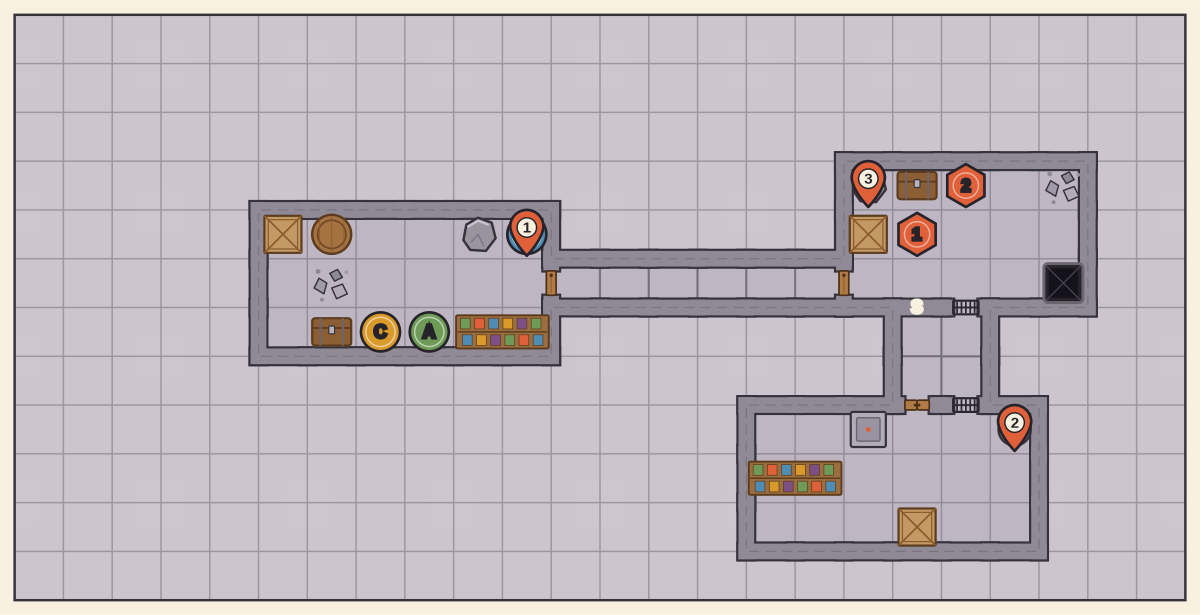
A dungeon drawn as a straight line has one problem that no amount of detail can fix. The group walks in, reaches the last room, and walks back through every room they just crossed. Each space is seen twice, and the second visit is dull.
This guide covers three tools that cure it: loops that offer a second route, shortcuts that shorten the way back, and dead ends that make the map feel like a place instead of a path. You will get sizes in squares, placement rules and a checklist to test your own layout.
Why a straight line wears thin
A line has exactly one route between the entrance and the goal. The group has no decisions to make about direction, and the return trip repeats the outward one. Adding side rooms helps a little, but the main route stays single.
A loop is a set of passages that leads back to where you started without reusing a passage. The moment one exists, the group has a choice and a reason to remember the map. A shortcut is a connection that makes a long trip short. A dead end is a passage that stops.
| Layout | Routes to the goal | The return trip | Effect at the table |
|---|---|---|---|
| Straight line | 1 | Same rooms again | Predictable and short-lived |
| Line with side rooms | 1 | Same rooms again | Better variety, same route |
| One loop | 2 | A different route is possible | Choices and a sense of place |
| Two linked loops | 3 or more | Several options | Varied, but harder to run |
Backtracking itself is not the enemy. A short retreat to a known room can be a relief after a tense scene. The trouble is a return trip that shows nothing new. Loops and shortcuts turn the same number of squares into fresh views.
For most maps, one loop plus one shortcut is plenty. Two linked loops suit a large map that the group will visit over several sessions.
Loops: giving the group a second way around
The smallest loop that feels like a loop has four rooms or halls around a solid block. Smaller circuits, such as a corridor ringing a single closet, read as a mistake.
Size the block first. A loop built around a solid block 8 squares wide and 6 squares deep needs about 28 squares of corridor along its edge. At 5 ft (1.5 m) per square, that is a walk of 140 ft (42 m), long enough that the two sides can hold different things.
Make the two sides of a loop unlike each other. One side might be a string of small rooms linked by doors. The other might be a long gallery with a single entrance at each end. If both sides look alike, the group will not notice that a loop exists.
Place a landmark that can be seen from both sides, such as a round chamber with a distinct floor. Seeing it twice tells the group: we have come back. For more on how hubs and forks feed a loop, see dungeon room flow.
Shortcuts: a way back that opens from one side
A shortcut is best when it works in one direction only. A gate that lifts from the inner side, a ladder that can be lowered, a wall of rubble that can be cleared from one face, a lever that opens a door: each one lets the group return quickly after the hard part, but gives nothing away on the way in.
Place the shortcut so it connects a late, difficult area to an early, safe one. The deepest hall back to the gatehouse is the classic pairing.
Let the group see the other side first. A gate with bars shows the entrance hall on the far side, and the group understands the promise before they can use it. A shortcut can also stay hidden until someone finds it, which is the subject of secret doors and hidden passages. A staircase can serve as a shortcut between floors, as shown in multi-level dungeon maps.
Dead ends: when a passage should stop
A dead end is not a flaw. Real buildings have them: a niche, a closet, a stair that stops at a wall. On a map, a few dead ends make the layout feel designed for something other than the group's visit.
Give each one a reason. Good reasons include a window onto another area, a locked gate that can be seen but not passed, a collapsed section (see ruins and collapsed halls), a short scene with a single creature, or a ledge above a drop. A dead end with an empty floor teaches the group to skip side passages.
Keep them rare. One or two per part of the map is enough. If every side passage ends in a wall, the group stops exploring. If none do, the map reads as a maze with a single route.
Mark dead ends with a clear cue: a wall that looks finished, a niche, a rubble pile. A dead end that looks like a hidden door will send the group searching for something that is not there.
Testing loops on your sketch
Use the Map Builder to sketch the layout in rough boxes first. Duplicate a wall run, rotate it in 90 degree steps and use undo while you test where passages meet. Count squares with the guidance in measuring distance on grid maps.
Test the sketch with two imaginary groups, one that always takes the left door and one that always takes the right. Both should reach the goal, and each should see rooms the other skips. Then walk back from the goal and count the squares. If the way home matches the way in, add a shortcut.
- At least one loop has four or more rooms or halls around a solid block.
- The two sides of each loop look different.
- A landmark is visible from both sides of the loop.
- Every shortcut connects a late area to an early one.
- Each dead end has a reason to exist.
- No more than two dead ends in each part of the map.
Common mistakes
- A loop that is too small. A corridor circling one closet is a ring, not a route. Build the loop around a solid block that measures 6 squares or more on each side.
- Matching sides. Two identical routes make the loop invisible. Change room count, width or door type on one side.
- A shortcut at the start. If it connects two early rooms, it saves nothing. Link a deep area to a shallow one.
- Empty dead ends. A stub with nothing in it teaches the group to ignore side passages. Add a view, a clue or a short scene.
- Loops everywhere. If every junction forms a circle, the group loses the sense of direction. Keep most of the map as sequences and forks.
FAQ
How many loops does a small dungeon need?
One is enough. A map of six to ten rooms with a single loop gives the group two routes to the goal and a reason to talk about direction. Add a second loop only when the map grows past roughly fifteen rooms or when you plan to return to it across several sessions.
What is the difference between a loop and a shortcut?
A loop is a second route that exists in both directions. A shortcut is a connection that usually works one way, or one way first, and exists to shorten a return trip. A loop is about choice on the way in. A shortcut is about relief on the way out.
Are dead ends bad design?
No. A dead end only becomes a problem when it has no reason to exist. A passage that stops at a barred window, a collapsed ceiling or a locked gate gives the group a question to carry forward. Keep the total low and make each one different.
How do players notice they have walked in a circle?
Give them a landmark. A room with a distinct floor, an unusual shape or a large piece of furniture will be recognized when it appears from a different door. Describe it the same way each time, and the group will make the connection.
Sources
- Hillier, Bill. Space Is the Machine: A Configurational Theory of Architecture. Cambridge University Press, 1996. For how the pattern of connections in a plan changes how people move through it.
- Hillier, Bill, and Julienne Hanson. The Social Logic of Space. Cambridge University Press, 1984. For general ideas about rings, branches and how layouts shape movement.
- Totten, Christopher W. An Architectural Approach to Level Design. 2nd ed. CRC Press, 2019. For how the structure of a level is planned around routes and choices.
- Kremers, Rudolf. Level Design: Concept, Theory, and Practice. A K Peters, 2009. For level design terms such as loops, shortcuts and pacing.
- Lynch, Kevin. The Image of the City. MIT Press, 1960. For landmarks, paths and how people form a mental picture of a place.