Dungeon room flow: how to connect rooms with hubs and branches
- By
- expenseforge.com
- Published
- Reading time
- 6 min
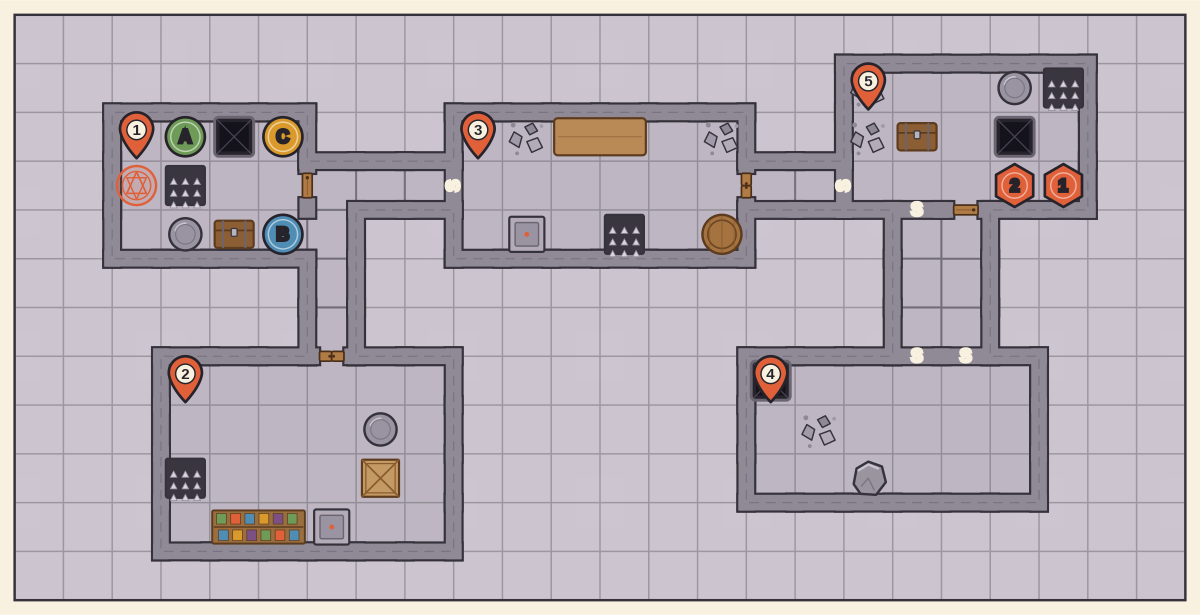
A dungeon map can have good rooms and still play badly. The group walks through a door, finds a room, walks through the next door, and by the sixth room nobody remembers where they started. Or the opposite happens: five exits open from the first chamber, the table freezes, and ten minutes go to choosing a direction.
This guide shows how to plan the connections before you draw a single room. You will learn the three shapes every layout is built from, how many exits a room should have, and how to trace a path across the map to check that the pace holds.
Three connection shapes: sequence, hub and branch
Every dungeon layout, large or small, is a mix of three shapes. A sequence is a line: room one leads to room two, which leads to room three. A hub is a room with three or more exits. A branch is a fork, where one passage splits into two that lead to different places.
Knowing the shape of each part tells you what the group will do there. In a sequence they move forward and react. At a hub they stop, talk and choose. At a branch they compare two options and commit to one.
| Shape | What the group does | Best use | Main risk |
|---|---|---|---|
| Sequence | Moves forward, reacts to each room | Entrances, build-up toward a big room | Feels like a tunnel past four rooms |
| Hub | Stops, regroups, picks an exit | Middle of the map, a central hall | Too many exits stall the table |
| Branch | Compares two paths and commits | A choice between two moods | One path gets ignored |
The table is a planning aid, not a law. A long hall with a door at each end is a sequence. The same hall with two extra doors on the long walls is a small hub. Count the exits and you know which one you drew. Most maps hold one or two hubs, a few forks and several sequences that stitch them together.
Choosing a hub and counting its exits
Place the first hub after two or three rooms, not at the entrance. A hub at the entrance asks the group to choose before they have learned anything. A hub deeper in gives them something to compare.
Three or four exits is a good range. With two exits, a hub is just a wide corridor. With five or more, the group loses track unless every exit looks different: one is an arch, one is a gate, one is a narrow passage and one is a stair. The door placement guide explains how each door type reads on the map.
Describe exits by what the group can see, not by compass direction. "The arch with the cracked keystone" is easy to remember across a table. "The third door on the north wall" is not.
Keep one exit pointing back toward the entrance. Groups like to know the way out, and a known return path makes the unknown exits feel safer to try.
Running a sequence without a tunnel effect
A sequence works well for two to four rooms. After that, a straight run starts to feel like a tunnel, because every door brings the same decision: open it and see. Break a long sequence by changing three things from one room to the next: size, shape and purpose.
For size, follow a large room with a small one. For shape, follow a rectangle with a round or L-shaped room. For purpose, follow a room that is only for passing through with one that asks the group to stop and look around.
Sizing each room for its job is a topic of its own, covered in dungeon room sizes.
Branches: how many choices to offer
At a fork, offer two paths. At a hub, offer three or four. More choices do not make a dungeon feel bigger. They make each decision feel heavier.
Make each branch different in kind, not only in direction. One path might be wide and straight, the other narrow and winding. A fork where both paths look the same is a guess, and players know it. Add a hint, such as a draft, a sound or scuff marks on the floor, so the group can reason instead of guess.
Decide early where each branch ends. A branch can lead to its own goal, rejoin the main path later or stop at a side room. Rejoining branches deserve a section of their own, which you will find in loops, shortcuts and dead ends.
As a spacing rule, a common choice is one fork every three or four rooms. Closer than that and the map turns into a maze. Farther apart and the group drifts along without deciding anything.
Tracing the flow before you commit
Before you draw walls in detail, sketch only rooms as boxes and connections as lines. Then walk the map on paper:
- Mark the entrance and the main goal with numbered pins.
- Trace the shortest path between them and count the rooms on it.
- Trace the longest path that does not repeat a room.
- Mark every hub and every fork.
- Check that no two hubs sit side by side.
Two hubs in a row give the group a double dose of choices. Separate them with at least one sequence room.
The Map Builder suits this stage: numbered pins and text labels on the Notes layer mark the route without touching the walls or the floor. Once the route looks right, test the rhythm against the advice in pacing sessions with maps.
- The shortest path crosses at least three rooms.
- Every hub has three or four exits that look different.
- No sequence runs past four rooms without a change of size or shape.
- Each fork leads to different kinds of places.
- There is a clear way back to the entrance.
Common mistakes
- A hub at the front door. Five exits in the first room force a choice with no information. Move the hub two or three rooms in.
- Identical exits. Four matching doors on one wall are impossible to describe. Vary the door type, the width or the direction.
- A spine with no forks. Ten rooms in a row read like a corridor with decorations. Add one fork and one hub.
- Hubs side by side. Two choice-heavy rooms in a row exhaust the table. Put a sequence room between them.
- Drawing detail first. Furniture and traps come last. Fix the connections while rooms are still plain boxes.
FAQ
How many rooms should a small dungeon have?
For a single scene or one short session, five to eight rooms is a comfortable range. Include one hub, one fork and a goal room that sits at least three rooms from the entrance. A small map with a clear shape plays better than a large map with no structure, and you can always attach more rooms later.
Can a dungeon have more than one hub?
Yes, as long as other rooms separate the hubs. A larger map might have a central hall and a second, smaller junction deeper in. Give each hub a different look, such as a round chamber and a long gallery, so the group can tell them apart when they return.
Should every room connect to a hub?
No. Most rooms should sit on a sequence or a branch, with only one or two hubs on the whole map. If every room opens onto the hub, the map becomes a star, and the group keeps returning to the same spot.
How can you show the intended route without spoiling it?
Keep your route marks on the Notes layer and switch that layer off before printing or sharing the map. The players see the rooms and doors, and you keep the numbered pins and labels for your own copy. Save one file with the marks for yourself, export a second version with the layer hidden, and look over the exported sheet before the session starts.
Sources
- Totten, Christopher W. An Architectural Approach to Level Design. 2nd ed. CRC Press, 2019. For how architects and level designers think about movement through connected spaces.
- Kremers, Rudolf. Level Design: Concept, Theory, and Practice. A K Peters, 2009. For general level design vocabulary such as paths, nodes and pacing.
- Hillier, Bill. Space Is the Machine: A Configurational Theory of Architecture. Cambridge University Press, 1996. For how the layout of connections shapes where people move and gather.
- Lynch, Kevin. The Image of the City. MIT Press, 1960. For paths, junctions and landmarks as the parts people use to find their way.
- Passini, Romedi. Wayfinding in Architecture. Van Nostrand Reinhold, 1984. For how clear choices help people find their way through buildings.